On this page
The short version
- Babies can begin solid foods at about 6 months, once they show signs they're ready.
- Choose foods that contain iron first — meat, egg, fortified infant cereal, beans, lentils or tofu — mashed or puréed very smooth.
- Offer one new single-ingredient food at a time, waiting 3 to 5 days between new foods.
- No honey, juice, cow's milk as a drink, added sugar or salty foods before 12 months.
What can a 6-month-old eat?
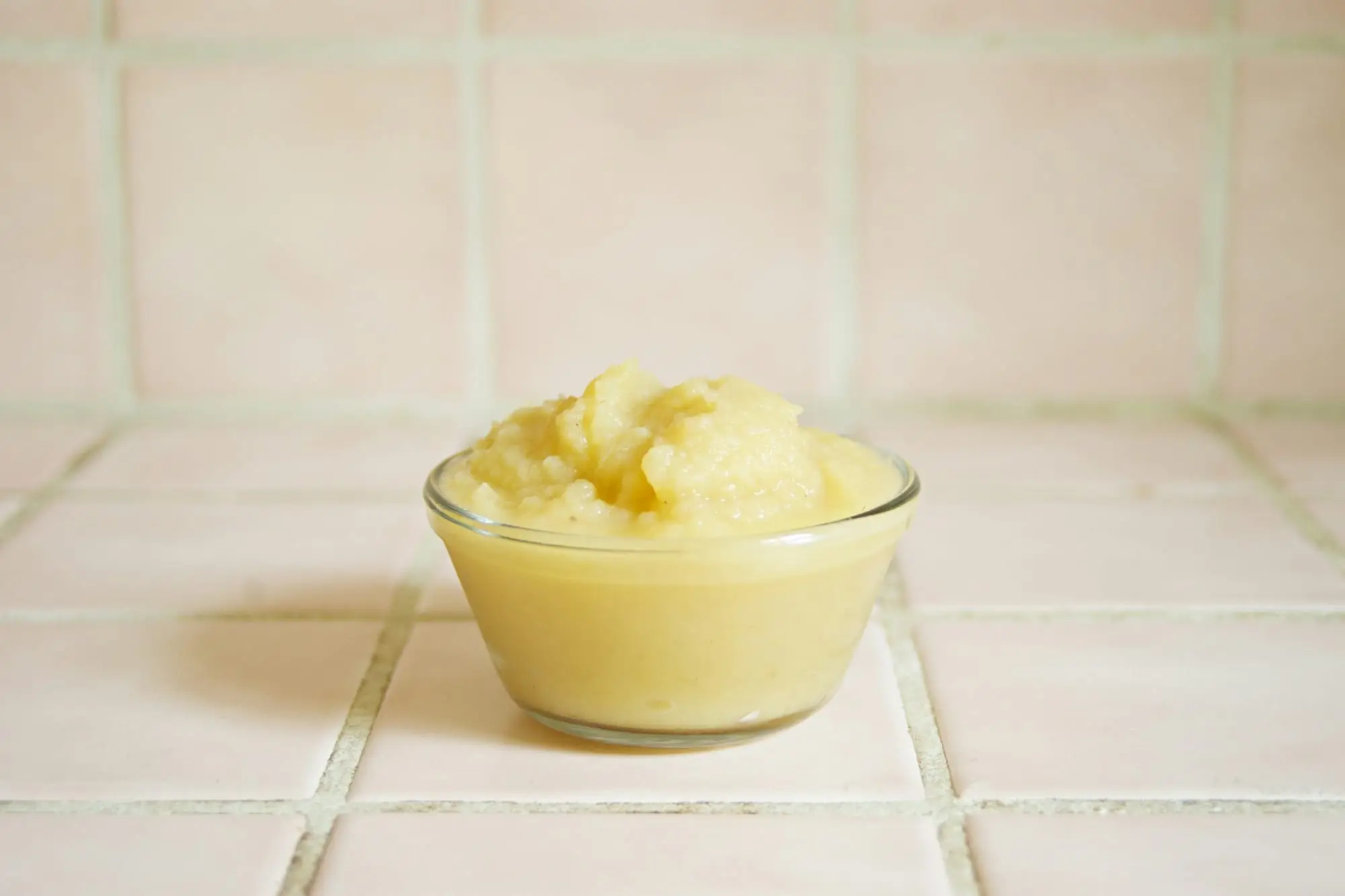
A baby can begin solid foods at about 6 months, according to the CDC, and the best place to start is with foods that contain iron.12 In practice that means smooth, mashed or puréed meat, poultry, egg, beans, lentils, tofu or iron-fortified infant cereal, with vegetables and fruit alongside.23
Babies are usually ready when they open their mouth as you offer food and swallow it instead of pushing it back out onto their chin.1 If yours isn’t there yet, it’s fine to wait a little; breast milk or formula is still doing the heavy lifting. The AAP recommends breast milk alone for about the first 6 months.3
How to start: texture and pace
At 6 months, the goal is practice, not a full stomach.
Start very smooth. The CDC says mashed, puréed or strained foods are easiest at first, and that foods should be soft enough to dissolve with saliva and not need chewing.1 If a food is too thick, the AAP suggests thinning it, then gradually thickening the texture.3
Keep the first tastes tiny. The AAP suggests starting with half a spoonful or less and building up slowly.3 Offer one single-ingredient food at a time, and wait 3 to 5 days before the next new one so you can spot a reaction.13 Once a food has gone well, it can be mixed with others.
Our guide to purées versus baby-led weaning covers the self-feeding route, and how much solid food a baby should eat explains amounts.
Best first foods for a 6-month-old
Iron comes in two forms. Heme iron, in meat, poultry and eggs, is absorbed more easily; non-heme iron, in fortified infant cereal, tofu, beans, lentils and dark green leafy vegetables, is less easily absorbed.2 Pairing non-heme sources with vitamin C-rich foods such as berries, broccoli, tomatoes, papaya or sweet potato helps.2
| Food | Smooth purée | Soft and mashed |
|---|---|---|
| Meat, poultry | Cooked until tender, blended with a little breast milk, formula or water | Finely shredded or minced, moistened well |
| Egg | Hard-cooked yolk and white mashed with liquid | Soft scrambled, mashed with a fork |
| Fortified infant cereal | Oat, barley or multigrain mixed thin with breast milk or formula | Thickened a little as your baby gets used to it |
| Lentils, beans | Cooked until mushy and puréed | Mashed flat; never whole |
| Tofu | Blended silky with fruit or vegetables | Mashed soft tofu |
| Sweet potato, squash, carrot | Steamed and puréed | Steamed very soft and mashed |
| Avocado, banana, pear | Mashed smooth | Mashed with a few soft lumps |
Don’t put infant cereal in a bottle, because your baby could choke.3 And vary the cereal: the CDC suggests oat, barley and multigrain rather than only rice, since feeding only rice cereal can increase the risk of arsenic exposure.1
What the first few weeks can look like
Because new foods go in one at a time, a sensible start is slow and a little repetitive. That’s by design, not a sign you’re behind.
- Week 1: one iron-rich food, such as puréed beef or oat cereal, for 3 to 5 days, then a second.13
- Week 2: add a vegetable or fruit, again one at a time, and start pairing it with the foods that went well.
- Week 3 onward: mix familiar foods into simple meals, and add allergenic foods like egg alongside the others.1
Texture changes gradually too. The CDC notes that by 7 or 8 months, babies can eat a variety of foods from different food groups.1 Until then, a spoonful that gets spat out is just practice. Offer it again another day.
Six simple meal ideas
Each of these uses foods your baby has already tried on their own. Serve a spoonful or two at a calm moment, when your baby is alert and not overtired, then offer breast milk or formula. Cook everything without salt or sugar, and warm it only until it’s comfortably lukewarm; stir well and test it on your wrist.
Easy first meals
- Oat cereal with pear. Iron-fortified oat infant cereal mixed thin, with pear mashed or puréed into it.
- Beef and sweet potato. Slow-cooked beef blended smooth with steamed sweet potato, which brings vitamin C along.
- Egg yolk and avocado. Hard-cooked egg mashed with avocado and a little milk or water.
- Lentils with tomato. Red lentils cooked until mushy and puréed with a spoonful of cooked tomato.
- Chicken, pea and apple. Chicken puréed with steamed peas, then a separate spoonful of cooked apple.
- Tofu and banana. Soft tofu blended with ripe banana until silky.
Yogurt without added sugars is fine before 12 months, so a spoonful of plain yogurt with mashed fruit works too.1
For more iron ideas, see iron-rich foods for babies, and protein for babies for the other building block. When your baby is a few months in, 9-month-old food ideas covers soft finger foods, and 10-month-old meal ideas has a full sample day with finger foods.
What about allergens?
The CDC advises introducing potentially allergenic foods, such as egg, nut butters and wheat, when you introduce other foods.1 Peanut should be thinned into a purée or a thin spread; the AAP warns against thick chunks of nut butter and whole nuts.6 If your baby has severe eczema or an egg allergy, talk to your pediatrician before introducing peanut.1 Our guide to introducing allergens to baby has the details.
Foods and drinks to skip before 12 months
- Honey, in any form — don’t give it before 12 months.4 It carries a risk of botulism, a serious illness; here’s why honey waits until 12 months.
- Cow’s milk as a drink — it isn’t recommended until after 12 months and can risk intestinal bleeding.14
- Juice — no fruit or vegetable juice before 12 months.4
- Added sugars and salty foods — infants shouldn’t have added sugars, and high-salt foods like canned foods and processed meats should be avoided.4
- Choking hazards — whole nuts and seeds, whole grapes, popcorn, hot dogs, meat sticks, chunks of cheese, marshmallows and hard or sticky candy.56
Have your baby sit up to eat, never in a car or stroller, and watch them the whole time.5 As foods get chunkier, the AAP says to cut them into pieces no larger than half an inch.6
When to talk to your pediatrician
Call your child's doctor if
- Your baby refuses solids for several weeks after you've started
- Your baby has a rash, vomiting or diarrhea after a new food
- Your baby has severe eczema or an egg allergy and you want to start peanut
- Your baby gags or coughs often at meals, or seems not to swallow
- You're unsure whether your baby needs vitamin D or iron drops
- Call 911 if your baby can't breathe, cry or make a sound, turns blue, or has swelling of the lips or tongue after eating
Never give vitamin or iron drops on your own; your pediatrician will tell you whether and how much. If your baby keeps turning away from the spoon, see why babies refuse solids.
Common questions
What are the best first foods for a 6-month-old?
Foods that contain iron, according to the CDC — such as puréed or mashed meat, poultry, egg, iron-fortified infant cereal, beans, lentils and tofu — served very smooth to start. Vegetables and fruits can be added alongside them.
How many times a day should a 6-month-old eat solids?
There's no fixed rule at this age. The AAP suggests starting with half a spoonful or less and building slowly, so begin with a taste or two. Follow your baby's cues and your pediatrician's advice on building up.
Do I have to start with rice cereal?
No. The CDC suggests offering a variety of fortified infant cereals such as oat, barley and multigrain instead of only rice cereal, because feeding only rice cereal can increase the risk of arsenic exposure.
Can a 6-month-old have eggs and peanut butter?
Yes — the CDC advises introducing potentially allergenic foods when you introduce other foods. Serve peanut butter thinned into a purée, never in a spoonful or thick chunk, and ask your pediatrician first if your baby has severe eczema or an egg allergy.
Can a 6-month-old have yogurt or cheese?
Yogurt without added sugars can be introduced before 12 months, according to the CDC. Cow's milk as a drink should wait until after 12 months.
Can I give my 6-month-old honey, juice or water to help with constipation?
Never honey before 12 months, and no juice. For constipation or questions about water, ask your pediatrician rather than adding drinks on your own.
Sources
- Centers for Disease Control and Prevention. When, What, and How to Introduce Solid Foods.
- Centers for Disease Control and Prevention. Iron — Infant and Toddler Nutrition.
- American Academy of Pediatrics, HealthyChildren.org. When Can Babies Start Solid Foods? Readiness & Feeding Tips.
- Centers for Disease Control and Prevention. Foods and Drinks to Avoid or Limit.
- Centers for Disease Control and Prevention. Choking Hazards.
- American Academy of Pediatrics, HealthyChildren.org. Choking Prevention for Babies & Children: What Every Parent Needs to Know.
This article is for general information and isn't a substitute for advice from your child's doctor. Our editorial standards.