On this page
- What should a healthy plate for a 5-year-old look like?
- Which foods should you offer?
- What does a whole day of food look like?
- What about snacks and drinks?
- Are some healthy foods still choking hazards?
- How much should they actually eat?
- What if they won’t eat the healthy stuff?
- When to talk to your pediatrician
- Common questions
The short version
- A healthy plate for a 5-year-old mixes a protein, a grain, a vegetable and fruit, with milk or yogurt at most meals.
- The AAP's sample dinner is 2 oz of protein, ½ cup of grain and ¼ cup of vegetables.
- Whole fruit beats juice, and sugary drinks are the main thing to limit.
- Grapes, hot dogs, nuts, popcorn and raw carrot sticks still need safe cuts.
What should a healthy plate for a 5-year-old look like?
A healthy plate for a 5-year-old has a protein food, a grain, a vegetable and fruit, with milk or yogurt alongside, in portions much smaller than yours. The American Academy of Pediatrics (AAP) sample dinner for a preschooler is 2 oz of meat, fish or chicken, ½ cup of pasta, rice or potato, ¼ cup of vegetable and ½ cup of milk.1
That menu was planned for a 4-year-old of about 36 lb, and the AAP’s guide covers ages 4 and 5 together,12 so the same foods suit both 4-year-olds and 5-year-olds. A bigger or more active child may eat more, and a smaller one less.
Which foods should you offer?
The AAP’s advice is simple: offer a range of healthy foods.2 Here is what that range looks like:
- Protein: beans, chicken, turkey, fish, lean hamburger, tofu and eggs.2 Children aged 4 to 8 need about 19 g of protein a day, which a protein food at each meal and milk or yogurt in between can help cover.5 Our protein guide for school-age kids has more.
- Grains: whole-grain cereals and bread are the AAP’s suggestions.2
- Fruit and vegetables: fresh fruit and vegetables, in whatever form your child will eat them.2 The AAP’s sample day includes ½ cup of fruit at breakfast and as a snack, and ¼ cup of a dark-yellow or dark-green vegetable at lunch.1 Fiber for ages 4 to 8 is set at 25 g a day;5 our fiber guide shows how to get there.
- Milk and yogurt: milk provides calcium and vitamin D to build strong bones.2 The AAP suggests nonfat or low-fat milk for children over 2.3
What does a whole day of food look like?
The AAP’s sample day gives each meal a shape:
| Meal | What to offer |
|---|---|
| Breakfast | ½ cup milk, ½ cup cereal, ½ cup cantaloupe, strawberries or banana |
| Morning snack | ½ cup milk, ½ cup fruit, ½ cup yogurt |
| Lunch | ½ cup milk, sandwich on whole-wheat bread with 1–2 oz of meat and cheese, ¼ cup vegetable |
| Afternoon snack | 1 tsp peanut butter on 1 slice bread, or 5 crackers, string cheese or cut-up fruit |
| Dinner | ½ cup milk, 2 oz meat, fish or chicken, ½ cup pasta, rice or potato, ¼ cup vegetable |
Butter, margarine or dressing is optional; the AAP says to give only 1 to 2 teaspoons.1 For a full day and a week of dinners built the same way, see what a 5-year-old should eat in a day and our 5-year-old meal ideas.
What about snacks and drinks?
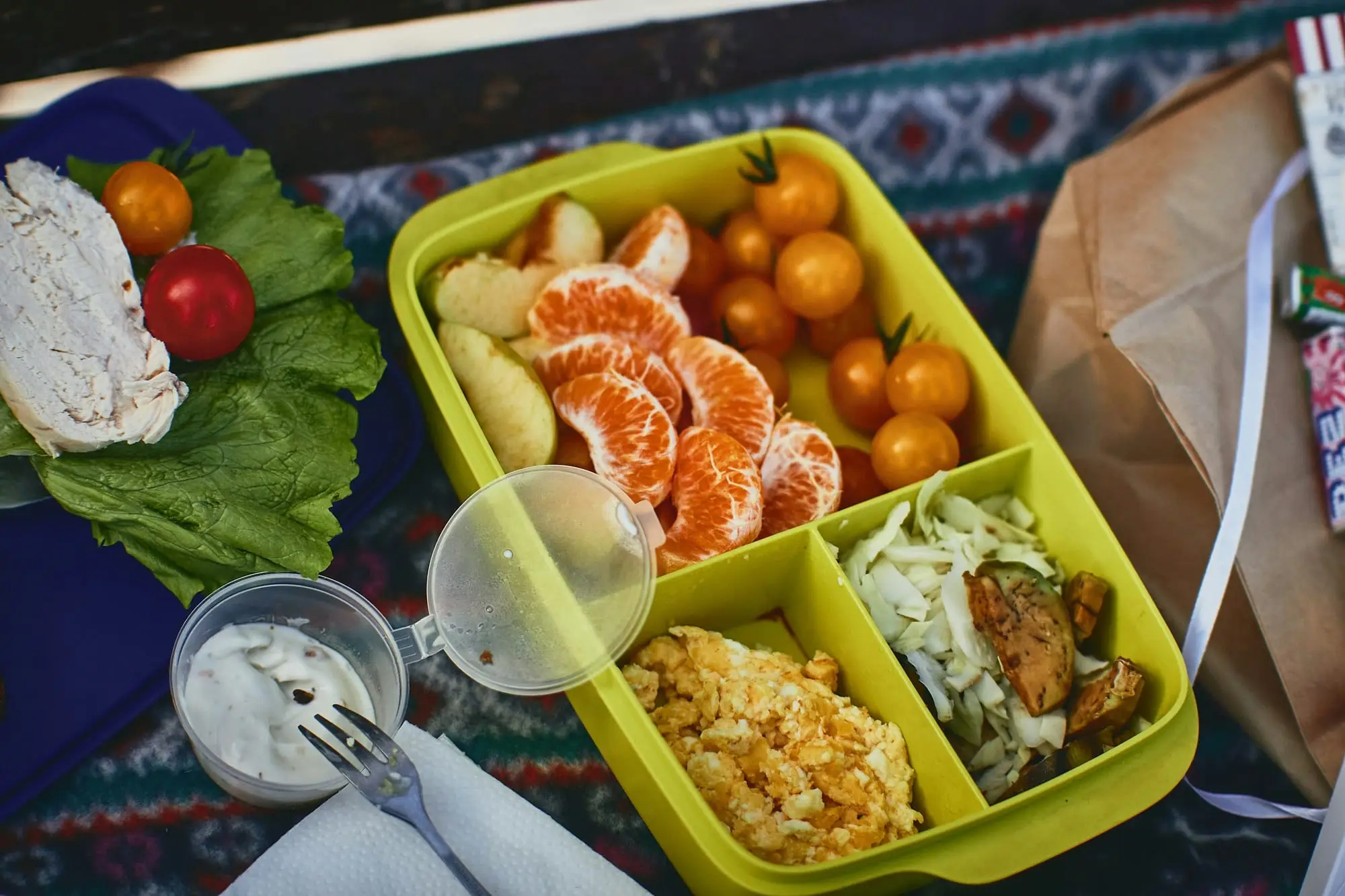
A growing preschooler needs 1 to 2 healthy snacks every day.6 Fresh fruit and vegetables, whole grains and low-fat dairy are the AAP’s suggestions.6 If your child likes dip with fruit or vegetables, the AAP suggests limiting it to 2 tablespoons.6
Snacks work best as small meals rather than filler. In the AAP’s sample day, the morning snack is milk, fruit and yogurt, and the afternoon snack is a teaspoon of peanut butter on bread, 5 crackers, string cheese or cut-up fruit.1 Notice that string cheese appears on the AAP’s menu and also on its choking list, so cut it into small pieces for your child.4
For drinks, 16–24 oz (2–3 cups) of cow’s milk a day is the AAP’s range for ages 2 to 5, with water between (8–40 oz).3 Juice is optional, capped at 4 to 6 oz a day at ages 4 to 5, and the AAP says eating fruit is better than drinking it.36 Flavored milk is best avoided because of added sugars,3 and the AAP says the most important thing is to limit sugary drinks.2 See how much juice a child should drink for more.
Are some healthy foods still choking hazards?
Yes. The AAP advises keeping the riskiest foods away until age 4 or older, depending on each child’s development and maturity, so many 5-year-olds can manage them, but only when prepared safely.4 Its list includes hot dogs, nuts and seeds, whole grapes, raw vegetables like carrot sticks, raw fruit chunks like apple pieces, popcorn, chunks of cheese or meat, and thick nut butter.4
How to serve them:
- Round, firm foods like hot dogs and grapes only when completely chopped into tiny pieces.4
- Everything else cut into pieces no larger than one-half inch.4
- Nut butter spread thinly, never in thick spoonfuls.4
- Seated, always. No running, walking, playing or lying down with food in the mouth.4
How much should they actually eat?
These portions are a starting point, not a quota. The AAP’s feeding guide says to let children choose their own portion sizes,2 and an appetite that swings from one meal to the next is normal. A child who ate little at lunch may eat a lot at the afternoon snack, so judge the pattern over several days rather than one plate.
A useful way to use the menu above is as a shape rather than a recipe. Each meal has a protein or dairy food, a grain, and some fruit or vegetable, and the snacks reuse the same building blocks.1 If you serve that shape most days, the details can vary as much as your child likes.
Three habits that make the plate easier
- Keep to a rhythm. Serve foods at regular meal and snack times, and sit together.2
- Make one meal a family meal. The AAP suggests making at least one meal a day a special, pleasant family time.2
- Serve small amounts of new foods. Put a little beside something familiar and don’t pressure your child to eat it.2
What if they won’t eat the healthy stuff?
Pickiness is common, and the AAP’s advice is calm: offer regular meal and snack times, sit together, let children choose their own portion sizes and don’t pressure them to eat.2 Something your child refuses this week may be a favorite next week, so keep offering it.6 If dinner is a battle, our guides to 4-year-olds who won’t eat anything and 5-year-old picky eater recipes have next steps.
When to talk to your pediatrician
Call your child's doctor if
- Your child is losing weight or falling across growth-chart lines
- They eat only a handful of foods and refuse whole food groups
- They often gag, cough or choke when eating, or have trouble swallowing
- They fill up on milk or juice and eat very little food
- You're planning a vegetarian, vegan or dairy-free diet and want to check for gaps
Don’t start vitamins or supplements without asking first. Your pediatrician can tell you whether your child needs anything beyond food.
Common questions
What are healthy foods for a 5-year-old?
Milk or yogurt, lean proteins such as beans, chicken, turkey, fish, tofu and eggs, whole-grain cereal and bread, and fresh fruit and vegetables, according to the AAP. Offer a range, in small portions.
How much should a 5-year-old eat at dinner?
The AAP's sample dinner for a preschooler is 2 oz of meat, fish or chicken, ½ cup of pasta, rice or potato, ¼ cup of vegetable and ½ cup of milk. The AAP also advises letting children choose their own portion sizes.
What are good foods for 4-year-olds?
The same ones. The AAP's guide covers ages 4 and 5 together, and its sample menu was planned for a 4-year-old of about 36 lb.
How many snacks does a 5-year-old need?
The AAP says a growing preschooler needs 1 to 2 healthy snacks every day. Fresh fruit and vegetables, whole grains and low-fat dairy make good choices.
Can a 5-year-old have juice?
Occasionally. The AAP limits juice to no more than 4 to 6 oz a day at ages 4 to 5, and says eating fruit is better than drinking it.
Can a 5-year-old eat grapes and hot dogs?
Yes, if they're prepared safely. The AAP says round, firm foods like grapes and hot dogs should be completely chopped into tiny pieces, and advises keeping the riskiest foods away until at least age 4, depending on the child's development.
Sources
- American Academy of Pediatrics, HealthyChildren.org. Sample One Day Menu for a Preschooler.
- American Academy of Pediatrics, HealthyChildren.org. Feeding and Nutrition Your 4 to 5 Year Old.
- American Academy of Pediatrics, HealthyChildren.org. Recommended Drinks for Children Age 5 & Younger.
- American Academy of Pediatrics, HealthyChildren.org. Choking Prevention.
- Health Canada, reproducing the National Academies Dietary Reference Intakes. Dietary Reference Intakes: reference values for macronutrients.
- American Academy of Pediatrics, HealthyChildren.org. Preschool Food & Feeding.
This article is for general information and isn't a substitute for advice from your child's doctor. Our editorial standards.