On this page
- How much should a child eat at a meal?
- What does a portion look like by age?
- How much should a 1- or 2-year-old eat?
- What does a whole day add up to?
- How much should a 4- or 5-year-old eat?
- Does my child have to finish the plate?
- When appetite is low, is it a problem?
- Serving food safely at small portions
- When to talk to your pediatrician
- Common questions
The short version
- A young child's serving is about one-quarter of an adult's, according to the AAP.
- A 1-year-old needs about 1,000 calories a day; a 2-year-old about 1,000–1,400.
- Offer small portions on small plates, then let your child decide whether to eat more.
- Appetite swings from meal to meal, so judge by the week and by growth, not by one plate.
How much should a child eat at a meal?
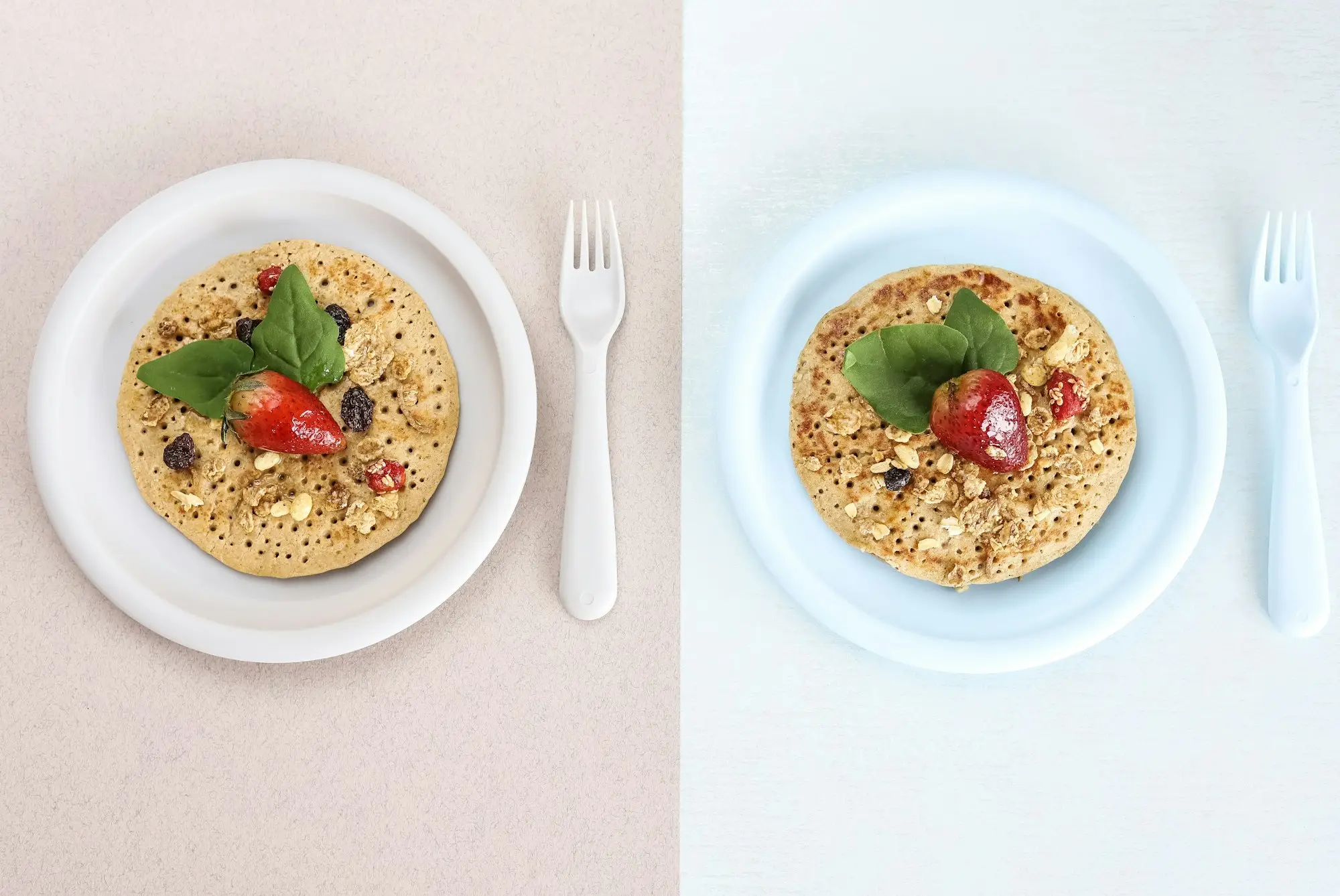
A young child’s serving is about one-quarter of an adult’s, according to the American Academy of Pediatrics (AAP).1 In real food, a toddler meal looks like 1 ounce of meat or 2 to 3 tablespoons of beans, 1 to 2 tablespoons of vegetables, 1 to 2 tablespoons of fruit and a quarter slice of bread.1
That looks tiny next to an adult plate, and it’s meant to be.
What does a portion look like by age?
The AAP gives amounts for toddlers and a few simple rules for older children. Treat every figure here as a starting point to offer, not a target your child has to hit.
| Age | Calories per day | Meals + snacks | A typical portion |
|---|---|---|---|
| 1 year | About 1,000 | 3 meals + 2 snacks | Quarter of an adult's: 1 oz protein, 1–2 tbsp each vegetable and fruit |
| 2 years | 1,000–1,400 | 3 meals + 1–2 snacks | Dinner: 2 oz protein, ⅓ cup grain, ⅓ cup vegetables |
| 3 years | Not set by the AAP pages we cite | Not set by the AAP pages we cite | About 3 tbsp cooked vegetables (1 tbsp per year of age) |
| 4–5 years | Not set by the AAP pages we cite | Regular meals and snacks | Smaller servings than an adult; about 4–5 tbsp cooked vegetables |
Calories first: 1-year-olds need about 1,000 a day across three meals and two snacks,2 and 2-year-olds about 1,000 to 1,400 depending on activity, with three meals and one or two snacks.3 For the day’s total, a 2-year-old’s food-group amounts are roughly 2 to 2½ cups of dairy, 1 cup each of fruit and vegetables and 1½ to 2 ounces of protein.3
How much should a 1- or 2-year-old eat?
After the first birthday, the AAP says you’ll probably notice a sharp drop in appetite, because growth slows.2 A child who ate everything at 10 months may now eat three bites and leave.
The AAP’s example 2-year-old dinner is about 2 ounces of fish, meat or cooked beans, ⅓ cup of pasta, rice or potato and ⅓ cup of vegetables.3 Some days that goes down easily and other days half of it comes back untouched. Both are normal.
For more detail, see our toddler portion size chart and how much a 1-year-old should eat.
What does a whole day add up to?
It helps to see the pieces together. The AAP’s sample day for a 2-year-old includes these amounts:3
- Breakfast: ½ cup of low-fat milk, ½ cup of iron-fortified cereal or 1 slice of whole-grain toast, ⅓ cup of fruit and 1 egg.
- Lunch: ½ cup of milk, half a sandwich, 2 to 3 carrot sticks or 2 tablespoons of another vegetable, and ½ cup of fruit.
- Snacks: 4 crackers with cheese or hummus, or ½ cup of cut-up fruit or berries, plus ½ cup of milk or yogurt later in the day. Cut berries and grapes small first.
- Dinner: ½ cup of milk or yogurt, 2 ounces of fish, meat or cooked beans, ⅓ cup of grain and ⅓ cup of vegetables.
Notice how much of the day is milk, fruit and small bites of everything else. A child who eats roughly like this over a week is doing well, even if no single meal looks impressive. Raw carrot sticks are a choking hazard for young toddlers, so cook them until soft or grate them for children who aren’t ready to chew them well.6
How much should a 4- or 5-year-old eat?
The AAP doesn’t give a single number for this age. It says 4- and 5-year-olds need smaller servings than adults, so use smaller plates, bowls and cups.4 The AAP’s tablespoon rule for cooked vegetables (1 tablespoon for each year of age) works out to about 4 to 5 tablespoons.1
Your job is to offer food at regular meal and snack times. Your child’s job is to decide whether they’re hungry and how much to eat.4 If you want ideas for the plate itself, try what a 5-year-old eats in a day.
Does my child have to finish the plate?
No. The AAP says it’s okay if children don’t eat everything on their plates, and that children at this age should learn to know when they’re full.4 The AAP also says not to pressure children to clean their plates.4
Two things make small appetites more reliable:
- Serve small, then top up. A big pile can put a child off before they’ve started. Let them ask for seconds.
- Keep to regular times. Children who graze all day may not be hungry at mealtimes.4
Drinks count too. The AAP suggests about 16 oz (2 cups) of milk a day at 12 to 24 months and 16 to 24 oz between 2 and 5 years,5 so a toddler who fills up on milk or juice may have no room left for dinner. Our guide to how much milk a toddler should drink can help you cut back.
When appetite is low, is it a problem?
Usually not. Intake tends to balance out over several days.2 Our guides to a toddler who eats a lot one day and nothing the next and a 2-year-old not eating much explain what’s typical.
Serving food safely at small portions
Small portions are also a good moment to check the shape of the food. The CDC lists uncut grapes and berries, whole or chopped nuts and seeds, hot dogs, popcorn and hard raw vegetables or fruit such as raw carrots and apples as choking hazards for young children.6 Cut or mash food to a size and texture that suits your child’s age, and have them sit upright while they eat.6
When to talk to your pediatrician
Call your child's doctor if
- Your child is losing weight or has stopped gaining weight or growing
- They refuse most foods or whole food groups for several weeks
- They seem unusually tired, weak or pale, or are eating very little and not drinking
- Mealtimes involve gagging, choking or coughing on food
- You're worried that they're eating too little or too much
Your pediatrician checks growth at each visit, and that’s the most reliable way to tell whether your child is eating enough. Don’t start any supplement or special diet without asking them first.
Common questions
How much food should a toddler eat per meal?
About a quarter of an adult's portion, per the AAP. A typical toddler meal is around 1 oz of meat or 2–3 tablespoons of beans, 1–2 tablespoons each of vegetables and fruit, and a small amount of grain. Offer a little and let them ask for more.
How much food should a 4-year-old eat?
There's no single fixed amount. The AAP says 4- and 5-year-olds need smaller servings than adults, and that your child decides how much to eat from what you offer. As a rough guide, the AAP's tablespoon-per-year-of-age rule gives about 4 tablespoons of cooked vegetables.
How much food should a 5-year-old eat?
Smaller servings than an adult, on smaller plates, with 3 meals and regular snacks. By the AAP's tablespoon-per-year rule that's about 5 tablespoons of cooked vegetables, but a day with less or more is normal.
Is it okay if my child doesn't finish their plate?
Yes. The AAP says it's okay if children don't eat everything on their plates, and that children at this age should learn to recognize when they're full.
Why does my toddler suddenly eat so little?
Growth slows after the first birthday, and the AAP says parents usually notice a sharp drop in appetite. Intake often evens out over several days.
How many calories does a toddler need?
The AAP says about 1,000 calories a day at age 1, divided among 3 meals and 2 snacks, and about 1,000 to 1,400 at age 2, depending on activity. You don't need to count; growth is the better check.
Sources
- American Academy of Pediatrics, HealthyChildren.org. Serving Sizes for Toddlers.
- American Academy of Pediatrics, HealthyChildren.org. Feeding & Nutrition Tips: Your 1-Year-Old.
- American Academy of Pediatrics, HealthyChildren.org. Sample Menu for a 2-Year-Old Child.
- American Academy of Pediatrics, HealthyChildren.org. Feeding & Nutrition Tips: 4-to 5-Year-Olds.
- American Academy of Pediatrics, HealthyChildren.org. Recommended Drinks for Children Age 5 & Younger.
- Centers for Disease Control and Prevention. Choking Hazards — Infant and Toddler Nutrition.
This article is for general information and isn't a substitute for advice from your child's doctor. Our editorial standards.