On this page
The short version
- Children aged 1 to 3 need about 4 cups (32 oz, ≈ 950 ml) of fluid a day, and that includes milk.
- It rises to about 5 cups (≈ 1.2 L) for ages 4 to 8 and 7–8 cups (≈ 1.7–1.9 L) for older children.
- Food adds roughly a quarter of a child's water on top of what they drink.
- Pale yellow, almost clear pee is the easiest everyday check that your child is drinking enough.
How much water a child needs, by age
Children aged 1 to 3 need about 4 cups (32 oz, roughly 950 ml) of fluid a day, according to the American Academy of Pediatrics — and that count includes milk as well as water.1 It rises to about 5 cups for 4- to 8-year-olds and 7–8 cups for older children.1
In real life, a toddler’s day might be 2 cups of milk with meals and about 2 cups of water through the day. That’s it — no special drinks, and no need to measure every sip.
| Age | AAP: drinks a day | National Academies: from drinks | Total water, food included |
|---|---|---|---|
| 1–3 years | About 4 cups (32 oz, ≈ 950 ml) | 0.9 L (≈ 30 oz) | 1.3 L |
| 4–8 years | About 5 cups (40 oz, ≈ 1.2 L) | 1.2 L (≈ 41 oz) | 1.7 L |
| 9–13 years, girls | 7–8 cups (56–64 oz, ≈ 1.7–1.9 L) | 1.6 L (≈ 54 oz) | 2.1 L |
| 9–13 years, boys | 7–8 cups (56–64 oz, ≈ 1.7–1.9 L) | 1.8 L (≈ 61 oz) | 2.4 L |
The two sets of numbers agree closely. The AAP gives a rounded cup count for drinks;1 the U.S. National Academies’ Adequate Intakes split water into what comes from drinks and what comes from food.3 Boys and girls need the same amount until age 9, when the National Academies start giving separate figures.3
These are averages, not targets for every child on every day. The National Academies based them on what healthy U.S. children actually take in, and say a wide range of intakes is compatible with normal hydration.3 The AAP adds that the amounts vary from child to child and go up with physical activity, heat and humidity.1
Does milk count? What about food?
Milk counts. The AAP’s 4 cups for toddlers is “fluids, including water or milk.”1 Here’s how it splits for younger children:
- 12 to 24 months: about 2 cups (16 oz) of whole milk and 1–4 cups (8–32 oz) of water a day.2
- 2 to 5 years: 2–3 cups (16–24 oz) of milk, nonfat or low-fat from age 2, and 1–5 cups (8–40 oz) of water.2
So a 2-year-old who drinks 2 to 3 cups of milk needs only about 1 to 2 more cups (240–475 ml) of water to reach the AAP’s total. If you’re wondering whether your toddler is drinking too much milk, our guide to how much milk a toddler should drink covers the limits.
Food counts too. In the National Academies’ figures, food supplies about 24% to 30% of children’s total water.3 Foods with a lot of water, such as many fruits and vegetables, add to fluid intake.5 Soup, yogurt, cucumber, oranges and melon all help. For toddlers and preschoolers, cut fruit and vegetables into small pieces: quarter grapes and cherry tomatoes, cut melon rather than serving it in balls, and skip chunks of hard raw vegetables.6
Your child doesn’t need to drink their whole number as plain water. Milk, food and water all add up.
Which drinks are best?
The AAP keeps it simple: the best drinks for young children are water and plain milk.2 Tap water also brings fluoride where the supply is fluoridated, which helps prevent tooth decay.2
Sodas, sports drinks, fruit drinks, lemonade and sweetened waters are drinks the AAP calls harmful to children’s health.2 Juice isn’t needed either. If you do serve 100% juice, the AAP’s limits are none before age 1, no more than 4 oz a day for ages 1 to 3, 4–6 oz for ages 4 to 6, and 8 oz for ages 7 to 18.1 See how much juice a child should drink for tips on serving it. For more on sweet drinks, see how much sugar a toddler should have.
Getting a reluctant drinker to drink more
Easy ways to get more water in
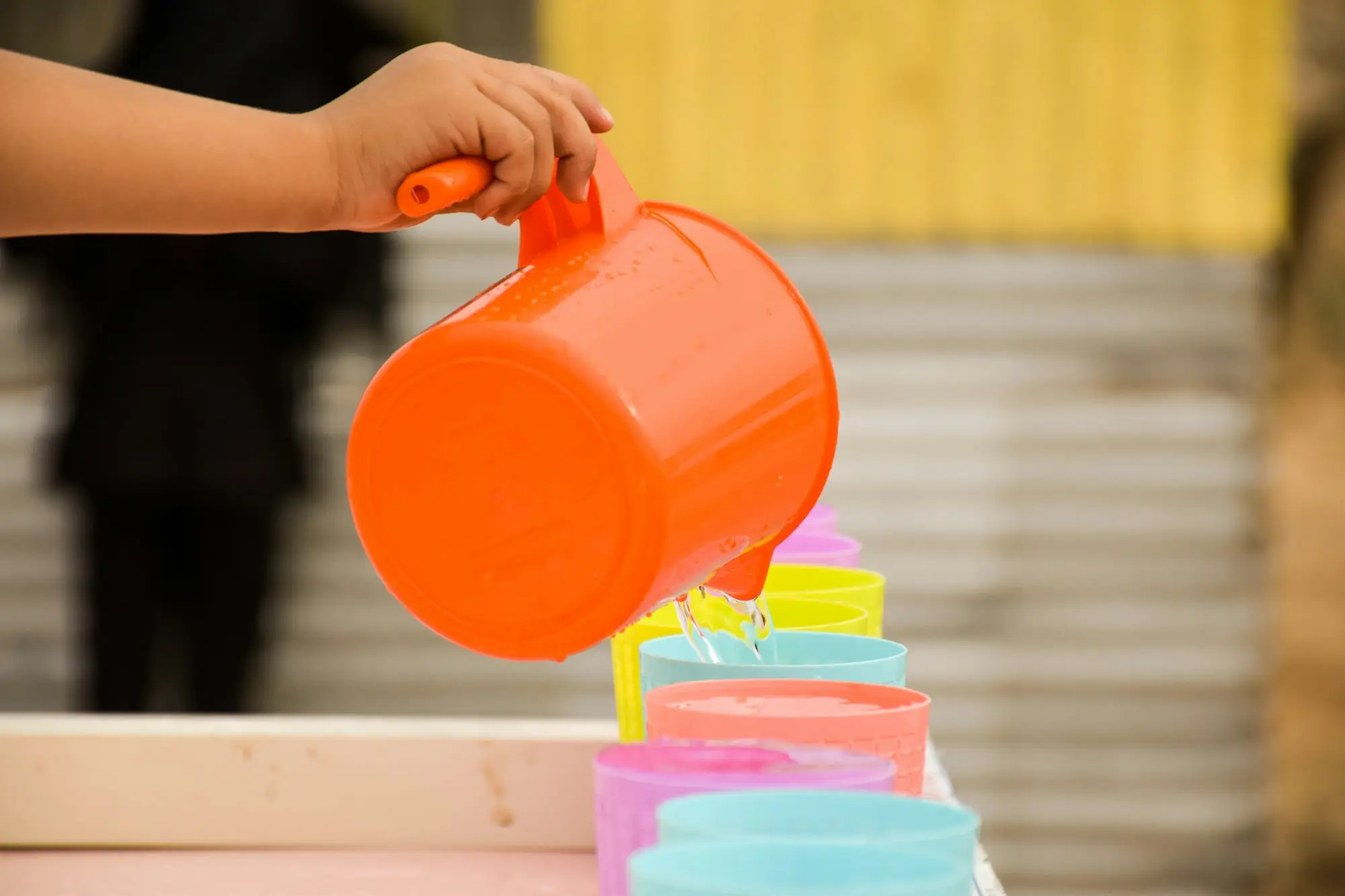
- Put it on the table. Serve water with every meal and snack, so drinking is part of the routine.5
- Make it portable. A child’s own refillable bottle in the bag or car makes water the easy option.5
- Keep it cold. Freeze water in a freezer-safe bottle so it stays ice-cold through a hot day.5
- Add a little flavor. A wedge of lemon or lime in the glass is enough for many kids.5
Thirst works well in healthy children. The National Academies note that thirst, combined with drinking at meals, keeps hydration at normal levels day to day.3 Offering water regularly matters more than hitting an exact number.
Hot days and sports
Children need more on hot, humid days and when they’re active.1 For sport, the AAP advises water before, during and after practices and games. Children aged 9 to 12 generally need about 3–8 oz of water every 20 minutes when exercising hard or sweating.1
Plain water is the right drink for nearly all kids’ activity. The AAP says electrolyte drinks may be needed only when vigorous exercise goes beyond an hour or a child is sweating a lot.1 See what young athletes should eat for game-day food, and can toddlers drink Gatorade for why sports drinks aren’t for little ones.
What about babies?
Babies under 6 months should have only breast milk or formula — the AAP does not recommend extra water at this age.1 From around 6 months, you can offer small sips of water from a cup, about 4–8 oz a day until their first birthday.12 Cow’s milk as a drink waits until 12 months.2 Our guide to when babies can have water covers amounts by age and how to offer it.
How to tell if your child is drinking enough
The easiest check is in the bathroom: pee should be very light yellow, almost clear.1 Signs an older child needs more to drink include dry lips or a sticky mouth, peeing less or dark-colored pee, being sleepy and irritable, and flushed skin.1
Call your child's doctor right away if
- Your child is playing much less than usual, has a dry mouth, or cries with fewer tears
- They're peeing much less than usual — fewer than 6 wet diapers a day for a baby, or only once or twice a day for an older child
- They're very fussy or unusually sleepy
- They have sunken eyes, or a baby or toddler has a sunken soft spot
- Their hands and feet are cool and discolored
These are signs of dehydration, and the AAP advises calling the pediatrician straight away if any of them appear.4 If your child is vomiting or has diarrhea, our guide to Gatorade and toddlers explains what to give instead.
Common questions
How much water should a 2-year-old drink?
The AAP says children aged 1 to 3 need about 4 cups (32 oz, about 950 ml) of fluid a day, counting milk. For a 2-year-old who drinks 2 to 3 cups of milk, that leaves roughly 1 to 2 cups (240–475 ml) of water, with more on hot or active days.
How much water should a 4- or 5-year-old drink?
About 5 cups (40 oz, about 1.2 L) of drinks a day for children aged 4 to 8, according to the AAP. Boys and girls need the same amount at this age.
Does milk count toward my child's fluid intake?
Yes. The AAP's figure of about 4 cups a day for toddlers explicitly includes water or milk. Water and plain milk are the two drinks it recommends for everyday use.
Do boys need more water than girls?
Not until about age 9. The U.S. National Academies set the same water intake for boys and girls up to age 8; from 9 to 13 it is about 1.8 L of drinks a day for boys and 1.6 L for girls.
Should babies drink water?
Not before 6 months — breast milk or formula is all they need, and the AAP does not recommend extra water. From about 6 months, babies can have small sips from a cup, about 4–8 oz a day until their first birthday.
Can a child drink too much water?
For a healthy child drinking normally, it's rare. The National Academies note that a wide range of intakes is compatible with normal hydration. If your child seems constantly thirsty or is suddenly drinking and peeing much more than usual, mention it to your pediatrician.
Sources
- American Academy of Pediatrics, HealthyChildren.org. Updated July 2024. Choose Water for Healthy Hydration.
- American Academy of Pediatrics, HealthyChildren.org. Recommended Drinks for Children Age 5 & Younger.
- Institute of Medicine (National Academies). Washington, DC: The National Academies Press; 2005. Summary, Tables S-1 and S-2. Dietary Reference Intakes for Water, Potassium, Sodium, Chloride, and Sulfate.
- American Academy of Pediatrics, HealthyChildren.org. Signs of Dehydration in Infants & Children.
- Centers for Disease Control and Prevention. March 2026. About Water and Healthier Drinks.
- Centers for Disease Control and Prevention. March 2026. Choking Hazards — Infant and Toddler Nutrition.
This article is for general information and isn't a substitute for advice from your child's doctor. Our editorial standards.